DIY Guide · Step-by-step
How to lay artificial grass yourself
A complete guide to DIY installation — from bare ground to finished result. 7 steps that make the difference.
Laying artificial grass yourself isn't difficult — but there are things that separate a half-decent result from a genuinely great one. The base, the trimming, the seams: that's where mistakes happen. This guide gives you the complete method.
Preparing the base
Remove existing grass and vegetation to a minimum depth of 10 cm. Use herbicide against deep-rooted weeds 2–3 weeks beforehand. Excavate and level so there is a fall away from the house (min. 1–2% slope for drainage).
Tip: A poor base cannot be fixed by good artificial grass. Invest the time here — it is the foundation for everything else.
Stabilising layers: hardcore and sand
Lay 8–10 cm of compacted hardcore (Type 1 or equivalent). Follow with 2–3 cm of sharp sand (0–4 mm) as a levelling layer. Use a spirit level and a screed board to ensure a perfectly flat surface.
For golf putting greens: avoid sand on top — use compacted fine grit instead, which gives the turf a firmer base with more consistent ball roll.
Weed suppression beneath the turf
Lay a geotextile membrane (weed barrier fabric) directly onto the finished sand layer before rolling out the grass. It keeps seeds out and prevents weed growth over time. Choose a density of at least 100 g/m².
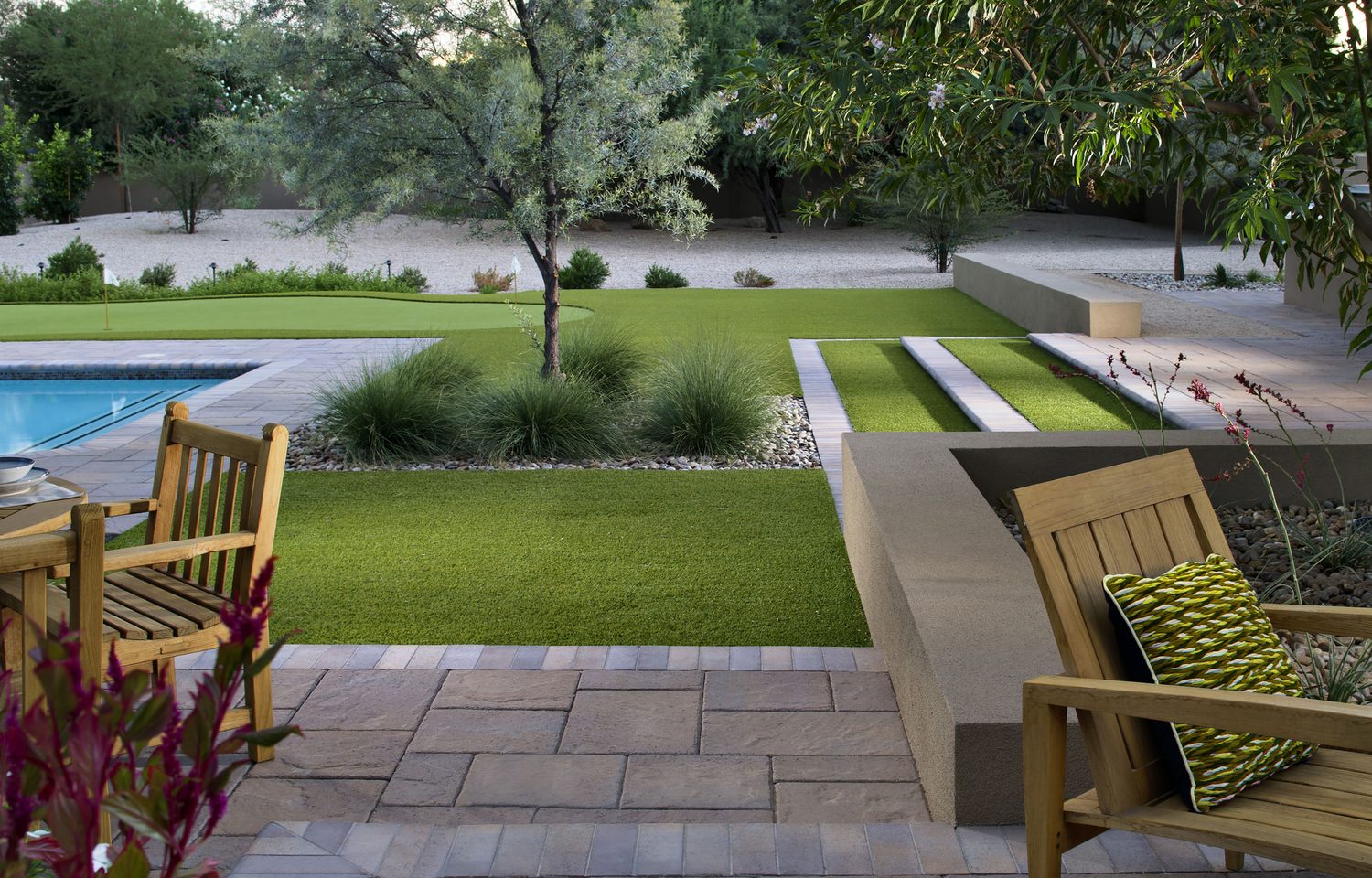
Roll out and trim the artificial grass
Roll out the turf and allow it to acclimatise for 1–2 hours, particularly in cold weather. Trim edges with a sharp utility knife or dedicated turf knife — never scissors. Keep the pile direction consistent throughout for a natural appearance.
For seams: overlap two pieces by 3–4 cm, cut along the centreline using a straight edge and knife, then join with seaming tape and adhesive underneath. The seam should be invisible.
Fixing and edge securing
Fix the edges with galvanised nails (50 mm) at approximately 15 cm intervals. Along edges against fencing, paving and walls, use either adhesive, a sand-filled edging strip, or a visible aluminium trim — depending on context and desired finish.
Infill: sand or rubber crumb
Most garden grass types require infill to keep the fibres upright. Use silica sand (0.5–1 mm) in the quantity stated on the product data sheet — typically 5–10 kg/m². Spread with a garden broom and work the sand down into the fibres.
For golf greens: use no infill on the putting green — a bare base gives the correct, consistent ball roll.
Brushing and finishing
Brush the artificial grass thoroughly with a stiff broom or power brush against the direction of the pile. This lifts the fibres and gives the final, natural appearance. Finish by rinsing off any dust and debris with a garden hose.
Download as PDF
Complete guide — ready to print or use offline
We're happy to answer questions directly
If anything in the guide is unclear, or you have a specific question about your project — give us a call. We're tradespeople, not salespeople.
Want us to handle the installation?
We offer complete installation — base preparation, laying and finishing. Contact us for a quote.